
A space for celebrating and learning about the Big Apple called dance
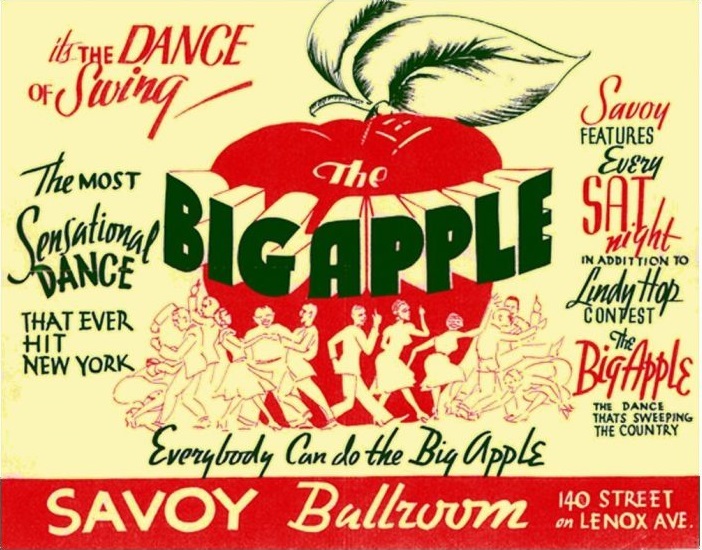
This website is dedicated to the Big Apple Call Dance.
Many dancers in the swing community are familiar with Frankie Manning's Big Apple choreographed dance. This isn't that dance. This is the dance that Manning's choreography was inspired by. For the whole story, check out our history section.
I have several goals in creating this resource. First, to share in a user-friendly form the calls and moves historically used in the Big Apple. Because there are hundreds of these calls, I can't document all of them. However, I intend to continue adding to them over time. Second, I'm developing my own skills as a caller in order to actually dance this dance regularly within our larger community. This allows us in our local scene to spend time together in a more informal setting than social dances, as well as to advertise our scene to the larger, non-dance community (and hopefully recruit some new dancers). Lastly, the Big Apple is just fun! Because it's called, and there's such a large number of potential calls, there's lots of opportunity for mistakes. Opportunities for us to create outside the box that is Lindy Hop, or Shag, or Balboa, or... that we sometimes feel stuck in. There's also opportunities to show off in a low stakes environment. What's not to love?!!?
Because I'm new to calling the Big Apple (TBH, I'm fairly new to the dance, but not many people in my community are familiar with it at all), I'm coming from the perspective of creating a tool that useful for both dancers and new callers. This means not just creating information about the call title and movement, but also about how to call it in a fun way. Back in the day (late 1930's on) all the cool cats used rhyming as part of their calling. As such, I'm creating some potential rhymes for each call. As I get experience, I'm sure I'll cringe at some of my old ideas as well as come up with new calls that are more fun, more useful to the dancers, or just plain different. I'll update individual pages as I do so. The upside here is that if you want to start having the Big Apple in your ocmmunity, you'll have plenty of resources for everyone to get started.
As an initial goal, I have about a dozen calls that I want to get documented. This means for each call having a text description of the movement as well as video examples. Going forward, I want to include (where appropriate) a basic movement video, an intermediate movement video, and examples of more experienced dancers, both contemporary and historical, adding their own flavor to these movements. Feel free to emulate these dancers OR create your own style. While some may quibble over perfect technique, it's my intent to show the entire spectrum. I'll try to identify examples that are "historically accurate" as well as "competition desirable" when appropriate for those who might be interested. But I also want to showcase movements by those dancers that we all just stare at when they're on the floor.